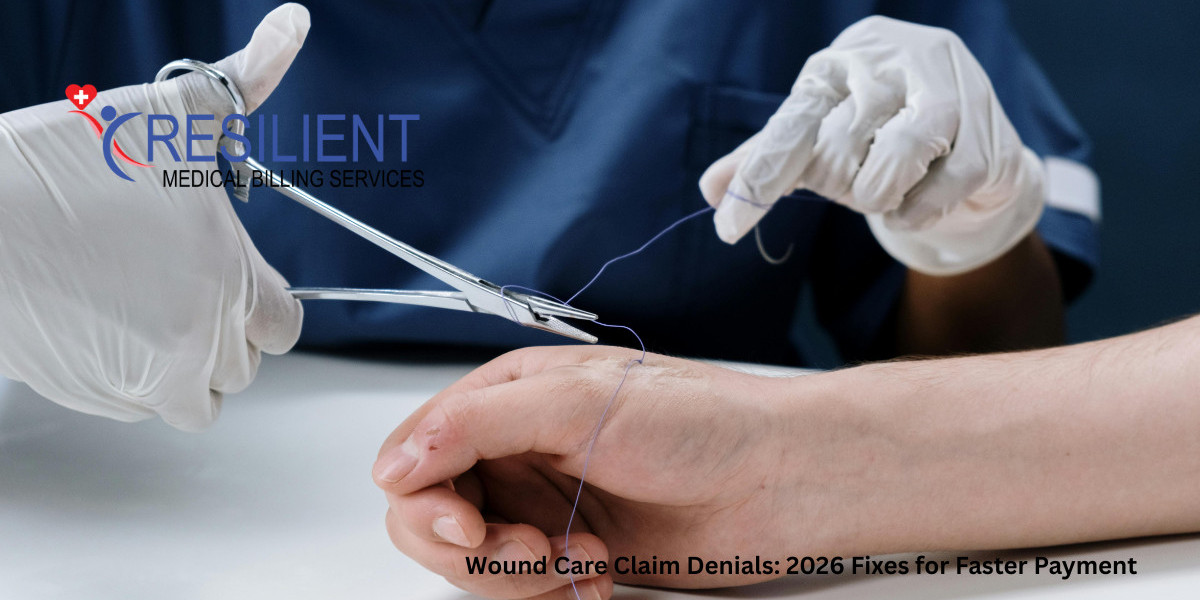

Wound care claim denials can occur even after a claim clears front-end edits. Missing measurements, unsupported debridement depth, incorrect product units, or weak medical-necessity documentation can delay payment across an entire treatment series.
Resilient MBS considers these risks especially important in 2026. Medicare Part B spending on skin substitutes exceeded $10 billion annually by the end of 2024, prompting payment reform, closer oversight, and increased attention to questionable billing patterns.
Faster payment does not come from resubmitting the same claim repeatedly. Resilient MBS recommends identifying the exact denial reason, selecting the correct recovery route, supplying focused evidence, and correcting the workflow that caused the problem.
https://resilientmbs.com/top-rated-medical-billing-company-in-topeka/
Why Wound Care Claim Denials Require New Controls in 2026
Resilient MBS advises billing teams to separate a claim rejection from an adjudicated denial. A rejection usually means the claim failed an initial data or formatting edit, while a denial means the payer processed the claim but declined payment for a stated reason.
Resilient MBS also recommends updating skin-substitute workflows. For 2026, CMS finalized payment for covered skin-substitute products as incident-to supplies when used with covered application procedures in nonfacility physician offices or hospital outpatient departments. CMS also adopted a single payment-rate approach based on three FDA regulatory categories.
Coverage policy remains more complicated than payment policy. Resilient MBS notes that CMS withdrew the new skin-substitute LCDs that had been scheduled for January 1, 2026, so billing teams must still check the currently applicable Medicare Administrative Contractor policy instead of assuming one national coverage standard.
https://resilientmbs.com/medical-billing-services-in-cincinnati/
Common Denial Reasons and the Correct 2026 Fix
Incomplete Wound Documentation
Resilient MBS frequently finds that the claim code appears reasonable, but the note does not prove what happened. Medicare guidance expects objective wound findings, medical necessity, instruments used, tissue treated, and evidence of continued benefit when repeated care is billed.
A defensible note should include:
Exact wound location and laterality
Current length, width, and depth
Drainage and tissue characteristics
Infection or necrosis findings
Tissue actually removed
Debridement technique and instrument
Surface area treated
Patient response
Updated treatment plan
Resilient MBS fix: Do not appeal with an entire chart and expect the reviewer to locate the evidence. Submit the relevant signed notes and identify the exact pages supporting the wound size, procedure, medical necessity, and treatment progress.
Incorrect Debridement Depth or Surface Area
Resilient MBS recommends coding debridement according to the deepest tissue actually removed, not the deepest tissue visible in the wound. A wound may expose muscle, but muscle-level debridement is not supported when the provider removed only subcutaneous tissue.
Resilient MBS also verifies whether the reported area represents the surface actually debrided. Debridement codes may be calculated by session and surface area rather than by the number of wounds, and current Medicare articles remain subject to NCCI and OPPS edits.
Common errors include:
Using the full wound size when only part was debrided
Combining wounds treated at different depths
Reporting separate base codes for wounds at the same depth
Selecting a surgical code for routine cleansing
Billing add-on units without a documented calculation
Resilient MBS fix: Recalculate the treated area from the original record. Correct the claim only when the existing signed documentation supports the new depth, code, or unit count.
Medical Necessity or Progress Is Not Clear
Resilient MBS treats a medical-necessity denial as an evidence problem. X12 defines CARC 50 as a noncovered service because the payer did not consider it medically necessary, while CARC 96 identifies a noncovered charge that requires an accompanying remark code.
Resilient MBS recommends connecting the clinical record to the payer’s coverage criteria. A diagnosis code alone does not explain why repeated debridement, a skin substitute, negative-pressure therapy, or another advanced intervention remained necessary.
The supporting record may need to show:
Wound duration and cause
Prior conservative treatment
Serial measurements
Vascular or perfusion evaluation
Offloading or compression
Infection management
Relevant comorbidity control
Measurable response
Reason for continued or changed treatment
Resilient MBS fix: Build the appeal around the payer’s stated coverage requirement. Quote or summarize the criterion, identify where the record satisfies it, and request a specific reconsideration of the denied service.
Authorization Does Not Match the Final Service
Resilient MBS sees authorization failures when approval exists but does not match the final product, procedure, quantity, provider, location, or date. X12 uses CARC 197 when required precertification, authorization, notification, or pretreatment approval is absent.
Resilient MBS fix: Compare the authorization record with the final clinical service before appealing. Submit a corrected claim when a valid authorization number was omitted. Request reconsideration when the payer overlooked matching approval. Review retrospective options when approval was never obtained.
Product Units, Wastage, or Bundling Are Incorrect
Resilient MBS recommends reconciling the wound area, package size, quantity applied, quantity discarded, HCPCS unit definition, and claim units before skin-substitute claims leave the billing system. The 2026 payment change does not remove the need for accurate product and application documentation.
Resilient MBS also checks whether related services are included in another payment. X12 defines CARC 97 as a service included in the allowance for another adjudicated procedure, which often requires an NCCI, contract, or payer-policy review rather than immediate modifier use.
Resilient MBS fix: Never add modifier 25, 59, or an X modifier only to force payment. Confirm that the edit permits separate reporting and that the medical record proves a significant, separately identifiable or otherwise distinct service.
| Denial pattern | First action | Best recovery route |
|---|---|---|
| Missing claim field | Read the remark code | Corrected claim |
| Unsupported medical necessity | Compare record with payer policy | Appeal |
| Incorrect units | Recalculate from signed documentation | Corrected claim |
| Missing authorization number | Confirm valid approval existed | Corrected claim |
| Authorization absent | Review retrospective options | Reconsideration or appeal |
| Bundled procedure | Review NCCI and payer policy | Appeal only when separately supported |
| Noncovered benefit | Verify plan coverage and patient notice | Contract or benefit review |
A Five-Step Workflow for Faster Denial Resolution
Step 1: Decode the Complete Remittance
Resilient MBS recommends reviewing the CARC, group code, Remittance Advice Remark Code, affected service line, payer policy reference, and appeal deadline. CARC 16, for example, identifies missing information or a billing error but requires the accompanying remark code to reveal what must be corrected.
Step 2: Choose Correction, Reconsideration, or Appeal
Resilient MBS uses a corrected claim for supported data changes, such as an omitted modifier, authorization number, or corrected unit count. Resilient MBS uses an appeal when the original claim was accurate but the payer made an adverse coverage, coding, authorization, or medical-necessity decision.
Step 3: Build an Evidence Map
Resilient MBS recommends a short appeal letter that maps every argument to a specific record page. Include the original claim, denial, relevant signed notes, authorization, measurements, treatment history, payer policy, and proof of timely submission.
A strong evidence map answers:
What service was denied?
Why did the payer deny it?
Which record disproves or resolves that reason?
Which policy supports payment?
What action should the payer take?
Step 4: Protect Every Deadline
Resilient MBS assigns an owner, submission date, payer confirmation, response date, follow-up date, and escalation route to every denial. Waiting for a provider response does not pause a payer’s filing or appeal clock.
Step 5: Correct the Root Cause
Resilient MBS groups denials by payer, provider, code, wound type, product, financial value, and cause. A recovered claim produces limited value when the same error continues across later dates of service.
https://resilientmbs.com/medical-billing-services-in-gresham/
Texas Wound Care Denial Controls
Resilient MBS advises Texas teams to verify whether an Original Medicare service falls within the current WISeR Model list. Texas participates in WISeR, which allows selected services to undergo prior authorization or prepayment medical review, and CMS has updated the operational code lists during 2026.
Resilient MBS also recommends separating Texas Medicaid fee-for-service rules from MCO requirements. TMHP implemented office-setting skin-substitute reimbursement updates for dates of service beginning June 1, 2026, while authorization and claims procedures may differ among managed-care organizations.
For Texas Medicaid fee-for-service, Resilient MBS notes that TMHP generally must receive denied-claim appeals and paid-claim adjustment requests within 120 days of the Remittance and Status Report disposition date. Managed-care appeals normally go to the applicable MCO.
Virginia Wound Care Denial Controls
Resilient MBS recommends checking Virginia Medicaid procedure files for current coverage and authorization indicators. Beginning January 1, 2026, Virginia Medicaid’s standard prior-authorization decision timeframe for applicable medical services changed from 14 calendar days to seven, while expedited decisions remain subject to a 72-hour timeframe.
Resilient MBS also stresses the difference between correction and appeal in Virginia Medicaid. DMAS states that filing an appeal does not correct the claim or cause reprocessing; providers should correct and resubmit fixable claim data instead. DMAS reports that corrected claims are typically processed within 30 to 60 days or sooner.
How Resilient MBS Reduces Repeat Denials
Resilient MBS helps billing teams connect wound documentation, procedure coding, authorization, product reconciliation, payment posting, and payer follow-up. The purpose is not to add modifiers until a claim pays. The purpose is to submit a defensible claim that remains accurate during review.
Resilient MBS recommends tracking:
Initial denial rate
Denied dollars
Documentation-related denials
Authorization failures
Appeal turnaround time
Appeal success rate
Product payment variance
Repeat-denial rate
Timely-filing losses
Billing teams can review Resilient MBS wound care billing services for support with claim review, denial recovery, coding controls, and payer-specific workflow improvement.
Frequently Asked Questions
What Causes Most Wound Care Claim Denials?
Resilient MBS commonly identifies incomplete measurements, unsupported debridement depth, incorrect units, weak medical necessity, authorization mismatches, bundling conflicts, noncovered services, and missed filing deadlines.
Should a Denied Wound Care Claim Be Corrected or Appealed?
Resilient MBS recommends correcting supported claim-data errors. Appeal when the original claim was accurate and the payer made an adverse medical-necessity, coverage, authorization, or coding decision.
What Documentation Supports a Debridement Appeal?
Resilient MBS recommends submitting wound measurements, tissue removed, debridement depth, treated area, instrument used, medical necessity, patient response, and the signed treatment plan.
Can a Modifier Fix a Bundled Wound Care Claim?
Resilient MBS uses a modifier only when current coding edits permit separate reporting and the documentation supports a distinct service. A denial alone does not justify modifier use.
How Quickly Should Billing Teams Work Wound Care Denials?
Resilient MBS recommends reviewing denials when they post, assigning an owner immediately, and protecting the payer’s correction or appeal deadline before collecting additional records.
How Can Practices Prevent Repeat Denials?
Resilient MBS recommends tracking root causes, auditing high-risk claims, correcting templates, educating providers, updating payer matrices, and measuring whether the denial returns after corrective action.
Recover Payment and Fix the Workflow
Resilient MBS teaches billing professionals to resolve wound care claim denials with evidence, not repeated submissions. Read the full remittance, choose the correct recovery route, protect the deadline, and build an appeal that directly answers the payer’s concern.
Resilient MBS can help practices identify high-value denials, strengthen documentation controls, and improve payer-specific workflows. Start with the denial category causing the most lost revenue, then correct it before another claim leaves the billing system.